



Commercial Heating Solutions – Big Valley Heating & Sheet Metal Ltd.
Ensure your Maple Ridge business remains warm and operational with our expert heating services. Call today for installations, maintenance, and emergency repairs.
Commercial Heating Failures Impact Revenue and Workflow
Winter months in Maple Ridge can severely impact your business operations due to inadequate heating solutions, leading to uncomfortable employees and dissatisfied customers. Ensure your commercial space remains warm, welcoming, and fully operational with our expert heating services; contact us today to schedule a site assessment or request emergency repair.
Business owners and facility managers know that a heating failure is not just an inconvenience; it is a direct threat to productivity. When a system goes down or performs inefficiently, energy costs spike while output drops. You need a partner who understands the urgency of commercial demands. Big Valley Heating & Sheet Metal Ltd. provides the technical expertise required to keep your climate control systems running without interruption.
- Swift and reliable installation and emergency repair services minimize downtime.
- Energy-efficient heating solutions are tailored specifically to your building's footprint and business needs.
- Comprehensive service plans include preventative maintenance and strategic upgrades to extend equipment life.
Backed by full licensed technicians and extensive warranties.
Today's Commercial Heating Technology: Efficiency and Reliability Delivered
Modern commercial heating is about more than just blowing hot air; it is about sophisticated climate control, air quality management, and operational expense reduction. Businesses in Maple Ridge operate in a specific climate where high humidity and damp cold penetrate structures differently than dry cold. The equipment installed today uses advanced heat exchange technology to combat this environment efficiently.
We provide a range of systems designed for specific commercial applications. Whether you manage a sprawling warehouse, a multi-story office complex, or a retail storefront, the technology available focuses on modulating output. This means the system adjusts its heating capacity based on real-time demand rather than cycling full-on and full-off, which wastes fuel and wears down components.
- Rooftop Units (RTUs): These are the standard for many commercial buildings. Modern RTUs come with economizers that utilize cool outside air when appropriate to lower cooling costs in shoulder seasons, and high-efficiency gas heat exchangers for the winter. They are packaged systems that save indoor space.
- Commercial Boilers: For facilities relying on hydronic heating, high-efficiency condensing boilers capture latent heat from exhaust gases. This process significantly increases the Annual Fuel Utilization Efficiency (AFUE) rating, often exceeding 95%.
- Variable Refrigerant Flow (VRF) Systems: These systems allow for heat recovery and simultaneous heating and cooling in different zones. This is ideal for buildings with varying thermal loads, such as a server room that needs cooling while adjacent offices need heating.
- Make-Up Air Units (MUA): In spaces with high exhaust rates, such as restaurants or industrial manufacturing, MUA units condition fresh air brought in from the outside. This prevents negative building pressure and ensures the indoor environment remains balanced and safe.
Seamless Installation Process: From Assessment to Execution
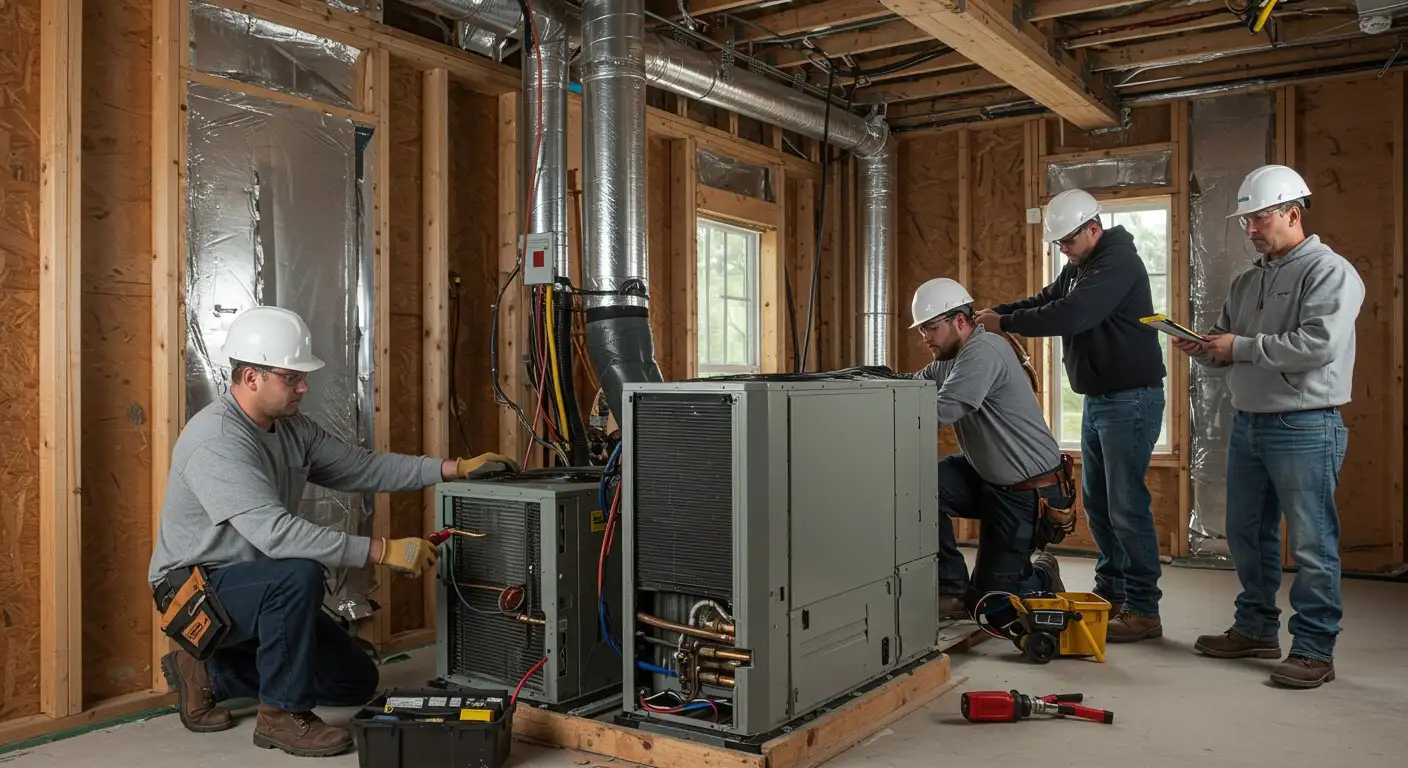
The installation of a commercial heating system involves complex logistics, engineering, and execution. A simple swap-out is rarely sufficient for commercial applications because building usage and codes change over time. Our process ensures that the new equipment matches the current load requirements of your facility.
The installation workflow focuses on minimizing disruption to your daily operations. We coordinate with your facility managers to schedule work during low-traffic periods whenever possible.
- Load Calculation and Engineering: Before any equipment is ordered, we perform a detailed heat load calculation. This accounts for square footage, ceiling height, insulation values, window surface area, and internal heat gains from machinery or occupancy.
- Site Inspection and Logistics: Commercial units are often large and located in difficult-to-access areas, such as rooftops. We arrange for necessary crane lifts, road closures if required, and safety barriers to protect your staff and customers during the lift.
- Ductwork and Piping Fabrication: Proper airflow is critical. We assess existing ductwork for leaks or design flaws. If necessary, we fabricate custom sheet metal transitions to ensure the new unit connects seamlessly to your distribution system without restricting airflow.
- System Commissioning: Once the physical installation is complete, the unit is not just turned on; it is commissioned. We calibrate gas pressures, check refrigerant charges, adjust blower speeds, and verify that all safety controls are functioning.
- Control Integration: We integrate the new heating plant with your Building Automation System (BAS) or install programmable commercial thermostats to give you granular control over scheduling and zoning.
Deciding Between Repair and Replacement: A Cost-Benefit Analysis
Facility managers frequently face the dilemma of authorizing another repair or investing in a capital expenditure for replacement. Making the wrong choice can drain your maintenance budget or leave you vulnerable to a catastrophic failure during a cold snap in Maple Ridge.
The decision should be based on data and return on investment (ROI); check available rebates. We help you navigate this by analyzing the total cost of ownership. If a system is nearing the end of its useful life, the efficiency gains of a new unit often offset the monthly loan payments for the installation.
- The 50% Rule: If the cost of a necessary repair approaches 50% of the value of the equipment (or the cost of a new unit), replacement is generally the smarter financial move.
- Frequency of Breakdowns: If your team is calling for service multiple times a season, the system has become a liability. The "nickel and diming" of frequent minor repairs adds up to more than a monthly payment on a new, warrantied system.
- Age of Equipment: Commercial RTUs and boilers typically last 15 to 20 years. If your equipment is in this age range, parts availability becomes an issue, and major components like heat exchangers are at risk of cracking.
- Efficiency Degradation: Older units lose efficiency over time due to scale buildup and component wear. A unit that was 80% efficient when installed twenty years ago may now be operating at 60%, meaning 40 cents of every dollar you spend on gas is wasted up the flue.
- Tenant Comfort Complaints: If you are receiving constant complaints about cold spots or drafts, the existing system may be undersized or unable to balance the air correctly. New systems with better zoning capabilities solve these dispute issues permanently.
Understanding Maple Ridge's Heating Needs: Local Climate Considerations
Operating a heating system in Maple Ridge presents specific challenges compared to other regions. While we may not experience the extreme sub-zero temperatures of the interior provinces, the maritime climate brings heavy rainfall and high humidity. This damp cold cuts through clothing and building envelopes, making 5 degrees Celsius feel significantly colder.
This environment impacts how commercial heating systems must be configured and maintained. High humidity levels mean that rust and corrosion are accelerated on outdoor units. Heat exchangers and cabinetry on rooftop units are particularly vulnerable if not specially treated or regularly maintained.
- Corrosion Protection: We inspect for signs of rust on heat exchangers and structural components. In this climate, ensuring the integrity of the cabinet prevents water ingress that can short out electrical boards.
- Humidity Control: Heating systems here need to do more than raise the temperature; they help manage indoor humidity. When cold, damp air is introduced into a building, it must be conditioned properly to prevent condensation on windows and mold growth in wall cavities.
- Permitting and Compliance: Maple Ridge has specific bylaws regarding noise for commercial equipment and gas safety regulations. We handle the permitting process to ensure your installation complies with all local codes.
- Drainage Management: Condensing boilers and furnaces produce water as a byproduct. In our freezing cycles, condensate lines must be properly insulated and routed to prevent freezing and backing up, which would shut down the system.
Preventative Maintenance to Reduce Operational Risks
Reactive maintenance is the most expensive way to run a facility. Waiting for a breakdown means paying emergency rates and suffering productivity losses. A proactive maintenance strategy moves heating costs from a variable, unpredictable expense to a fixed, budgetable line item.
Commercial equipment runs longer and harder than residential systems. Filters load up faster, belts wear out quicker, and electrical connections loosen due to vibration. Regular service visits catch these issues before they result in a shutdown.
- Heat Exchanger Inspection: We use cameras and combustion analyzers to check for cracks in the heat exchanger. A cracked exchanger can leak carbon monoxide into the building, posing a severe liability and safety risk.
- Belt and Pulley Adjustment: Loose belts reduce airflow and lower efficiency. We replace worn belts and align pulleys to ensure maximum air movement.
- Gas Pressure Calibration: Incorrect gas pressure leads to poor combustion. We adjust the manifold pressure to the manufacturer's specifications to ensure you get the rated efficiency from the unit.
- Sensor Calibration: Thermostats and sensors drift over time. We recalibrate them to ensure the temperature displayed is the actual temperature in the space.
Why Partner with Big Valley Heating & Sheet Metal Ltd.
Selecting a service provider is about trust and technical capability. You need a team that understands the commercial landscape and respects the operational tempo of your business. We do not use subcontractors for our core technical work; our technicians are directly employed, vetted, and continuously trained on the latest commercial HVAC technologies.
Our focus is on long-term partnerships rather than one-off transactions. We maintain a detailed service history for every piece of equipment we manage. This allows us to spot trends, predict failures, and offer strategic advice on capital planning for equipment replacement. When you call us, you are speaking to local experts who know the area, know the codes, and know how to keep your business warm.
Schedule Now
For reliable, professional, and code-compliant commercial heating services in Maple Ridge, take action before the weather turns.
Secure your facility's comfort and efficiency today; contact us at Big Valley Heating & Sheet Metal Ltd. to schedule a comprehensive heating audit or request immediate service.
Customer Testimonials
Our customers consistently share their satisfaction with our professionalism, prompt service, and the lasting comfort we bring to their homes.